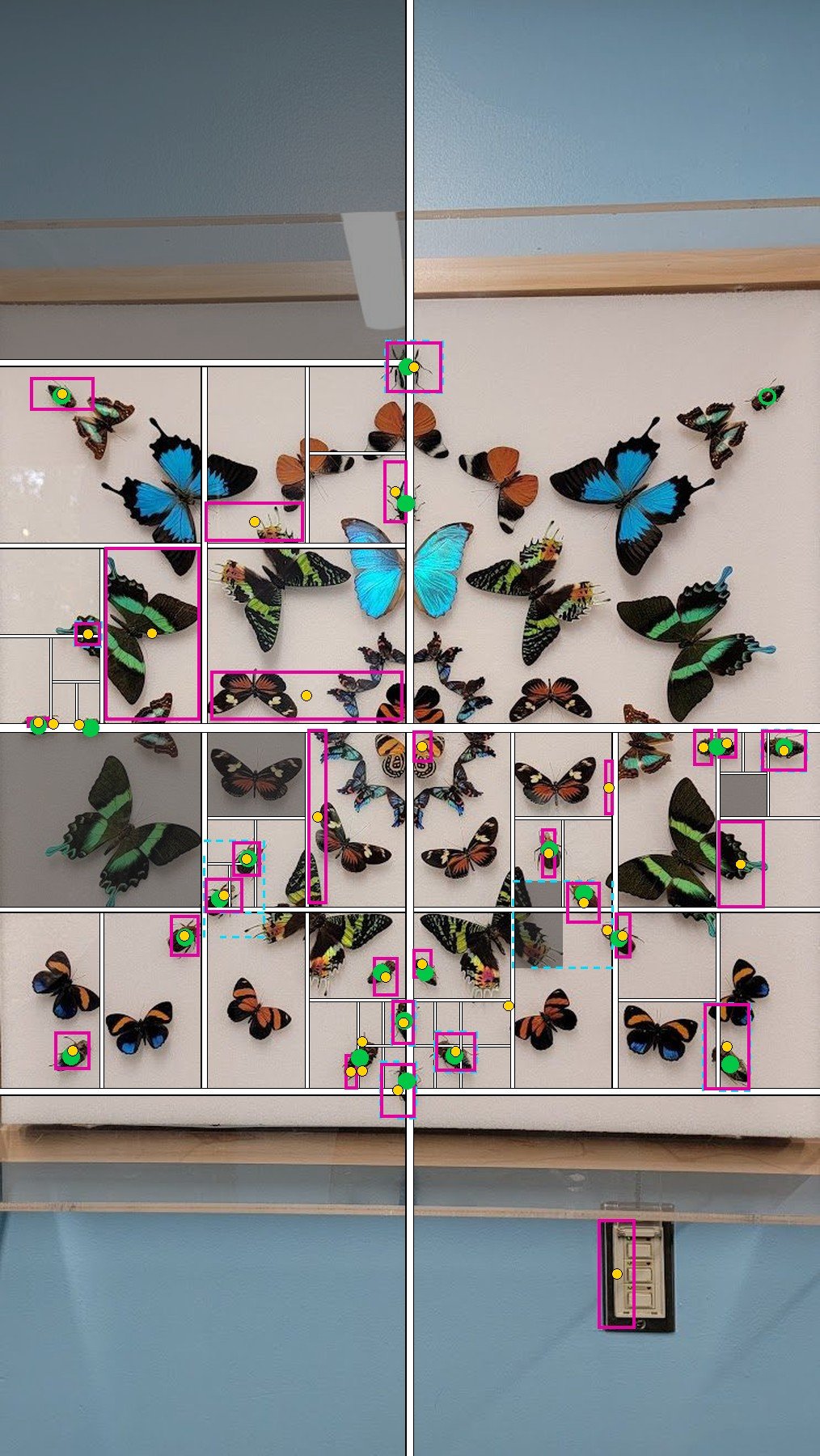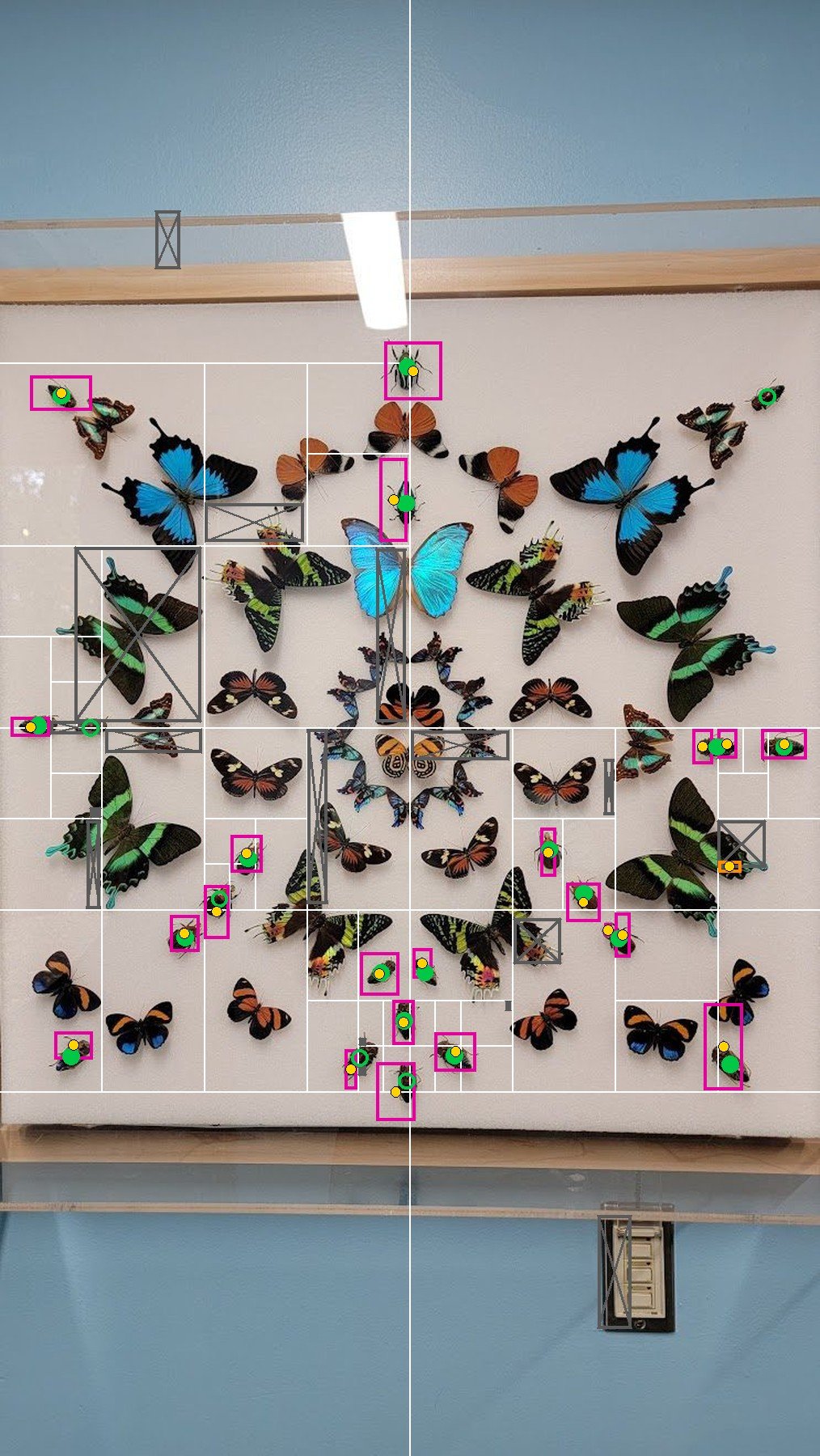

Here's an example of stacking jev on jev inspired by Lily. Jev divides and conquers an image to find a bunch of bounding boxes. For straightforward detection it's worse/slower than SAM3 but for something intelligent - like finding all sheep who might "yee haw" - it does well.
Recursive Decision Models
or, Operating System One
Raymond Weitekamp
What if “reasoning” was actually many small decisions?
RLM × Jev ⇒ RDM

Last time
Recursive Coding Agents
- The bottleneck is not intelligence. It's reliability. It's trust.
- RLMs are the new reasoning models.
- Trick question: RLMs are Recursive Coding Agents.
Watch the talk on the AI Engineer YouTube channel · recursivecodingagents.com
RLM / LLM
Root RLM (depth=0)
├── Sub-RLM A (depth=1)
│ ├── LLM A1 (depth=2)
│ └── LLM A2 (depth=2)
└── Sub-RLM B (depth=1)
├── LLM B1 (depth=2)
└── LLM B2 (depth=2)RDM / Decision
Root RDM (depth=0)
├── Sub-RDM A (depth=1)
│ ├── Decision A1 (depth=2)
│ └── Decision A2 (depth=2)
└── Sub-RDM B (depth=1)
├── Decision B1 (depth=2)
└── Decision B2 (depth=2)RLM / LLM
Root RLM (depth=0)
├── Sub-RLM A (depth=1)
│ ├── LLM A1 (depth=2)
│ └── LLM A2 (depth=2)
└── Sub-RLM B (depth=1)
├── LLM B1 (depth=2)
└── LLM B2 (depth=2)RDM / Decision
Root RDM (depth=0)
├── Sub-RDM A (depth=1)
│ ├── Decision A1 (depth=2)
│ └── Decision A2 (depth=2)
└── Sub-RDM B (depth=1)
├── Decision B1 (depth=2)
└── Decision B2 (depth=2)RLM / Decision as a tool
Root RLM (depth=0) ├── Decision A (depth=1) ├── Sub-RLM B (depth=1) │ ├── Decision B1 (depth=2) │ └── LLM B2 (depth=2) └── LLM C (depth=1)
RDM / LLM as a decision
Root RDM (depth=0)
├── Sub-RDM A (depth=1)
│ ├── Decision A1 (depth=2)
│ └── LLM A2 (depth=2)
└── Sub-RDM B (depth=1)
├── Decision B1 (depth=2)
└── Decision B2 (depth=2)What if “reasoning” was actually many small decisions?
Recursive Decision Models
A decision that can decide to make another decision.
Three rules
- 1The context stays outside the model, and code cuts it into slices.
- 2A decision can choose to call another decision, up to a maximum depth.
- 3It works with no generative model at all, and it composes with LLMs and agents.
Decisions all the way down
What if the pins could decide?
Same number. Any color.
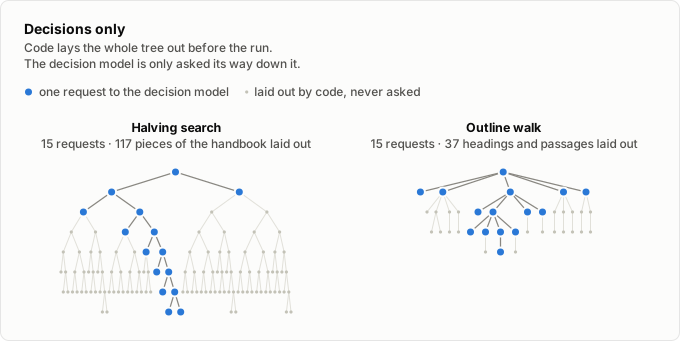
Hierarchical search, without the beam
Hierarchical search
Twelve thousand categories, and no request shows more than one level of them. Each answer decides which categories to ask about next: every one at least half as likely as the likeliest. The same walk as TypeSafe's hierarchical classification cookbook, without the beam.
recursivedecisionmodels.com/hierarchy ↗Laptop backpack with a padded sleeve, 20 litres.
A replay, not a live run. The laptop backpack, board game and hiking backpack are Laya's recorded answers (a 450 MB decision model, in the browser). The cat perch and headphones are an oracle replay: the right path, with odds set by hand.
Replying to @lotusfracture
First image, increase number of image cuttings allowed up to 15 times. Second, same but also included feedback. Each produced box is checked and asked if correctly on a beetle. If no, repeat cycle, if yes keep the box.
Greyed squares, Jev said no beetle. Other squares, Jev said 1 beetle then asked to produce the box.
Green dot, ground truth. Pink box, Jev box. Yellow dot, Jev box centroid. Blue dotted box, independent cuts for another test (can ignore here).
Overall, the feedback loop helps throw away bad boxes but doesn't help finding more. 1 correct beetle was rejected too.
Nice trick! :)


What if “reasoning” was actually many small decisions?
Decisions can only choose from what code has already laid out.
Pure decisions need every option filled in ahead of time. For games, browsers and computer use, that might be enough.
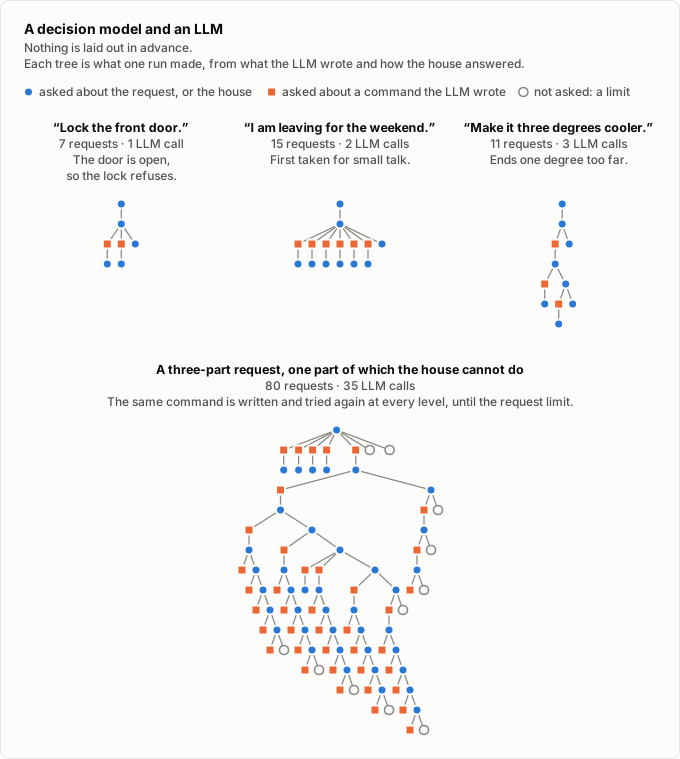
It must compose with LLMs
An LLM fans out options, a decision model keeps one or two, and each one kept opens a smaller fan.
Generation x Decision Demonstrate Emergent Graphs
A decision model can only point, so something has to say what it is pointing at.
A map links decision models to LLMs: names, each with a description for the model and a thing for the code.
What worked goes back on the map
Fast and cheap means we can speculate
Run many decisions at once, and let the system decide which to trust.
Operating System One


Radical HCI
spent some time this weekend getting back to my roots in real-time machine learning
this is a recursive decision model, deciding when it can decide that a fast decision is decisive enough
as the rdm learns from repetition, it autonomously begins to trust a very small model
by the end of the video the full computer use response time is ~45 ms
decision agents are here
We put up a version of hunch that you can play Pictionary against in your browser (no server!). It's really good, even if your drawings are not.
No Jev or OpenRouter calls here, nothing leaves your system! All powered by @GoogleGemma's EmbeddingGemma 2.
https://tryhunch.dev/pictionary
How can we decouple our bodies from our devices?
What would it mean to work on a computer without touching it?
What would it mean to work on a computer without being able to see it?
Operating System One
Join the waitlist at oSo.computer
oSo is…
- …a computer use agent built on RDM
- …a recursively improving system that learns on-the-fly
- …a tool to control your computer without touching it
- …an experiment in radical human computer interfacing
- …real-time machine learning
Operating System One
Join the waitlist at oSo.computer